
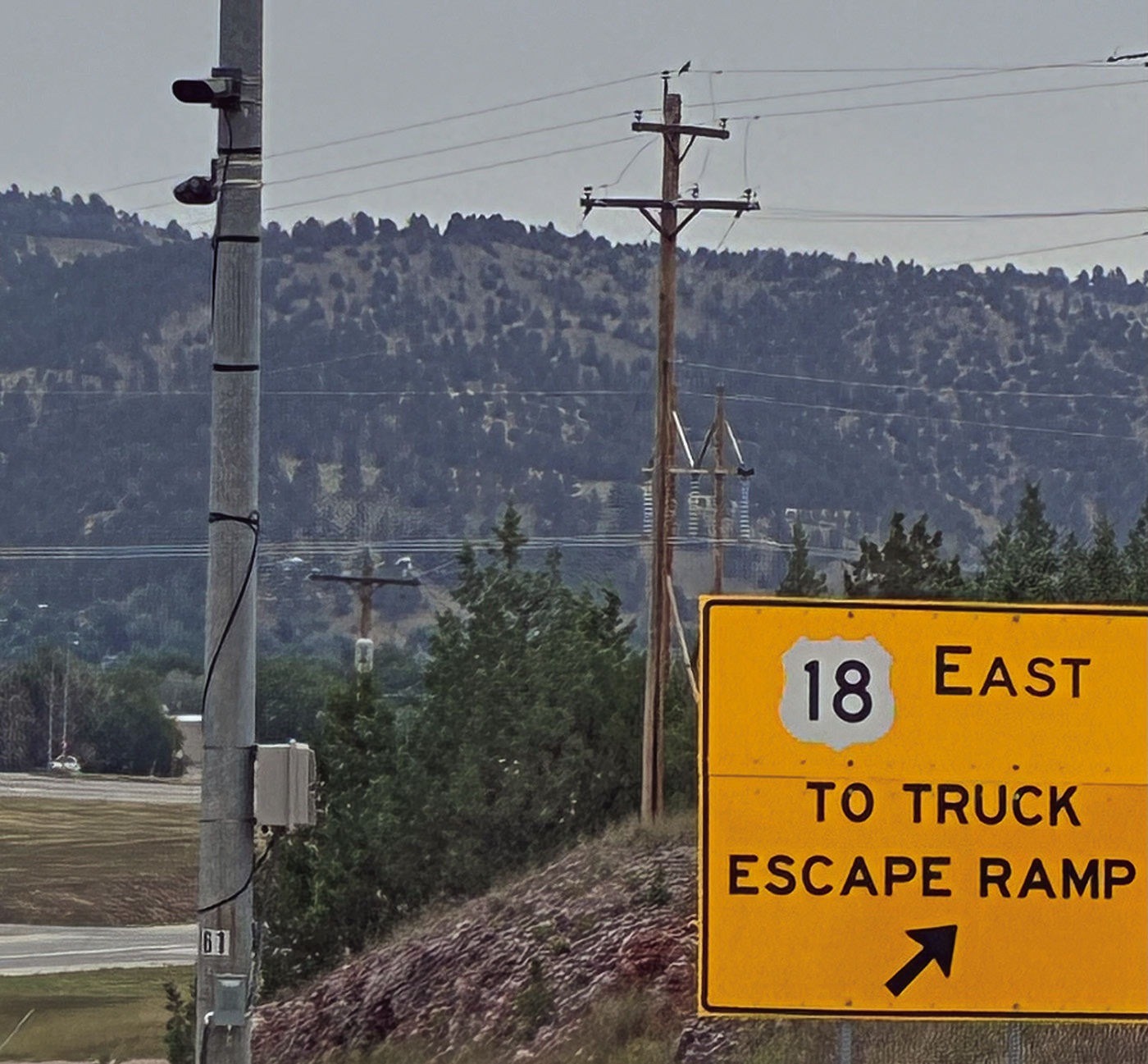
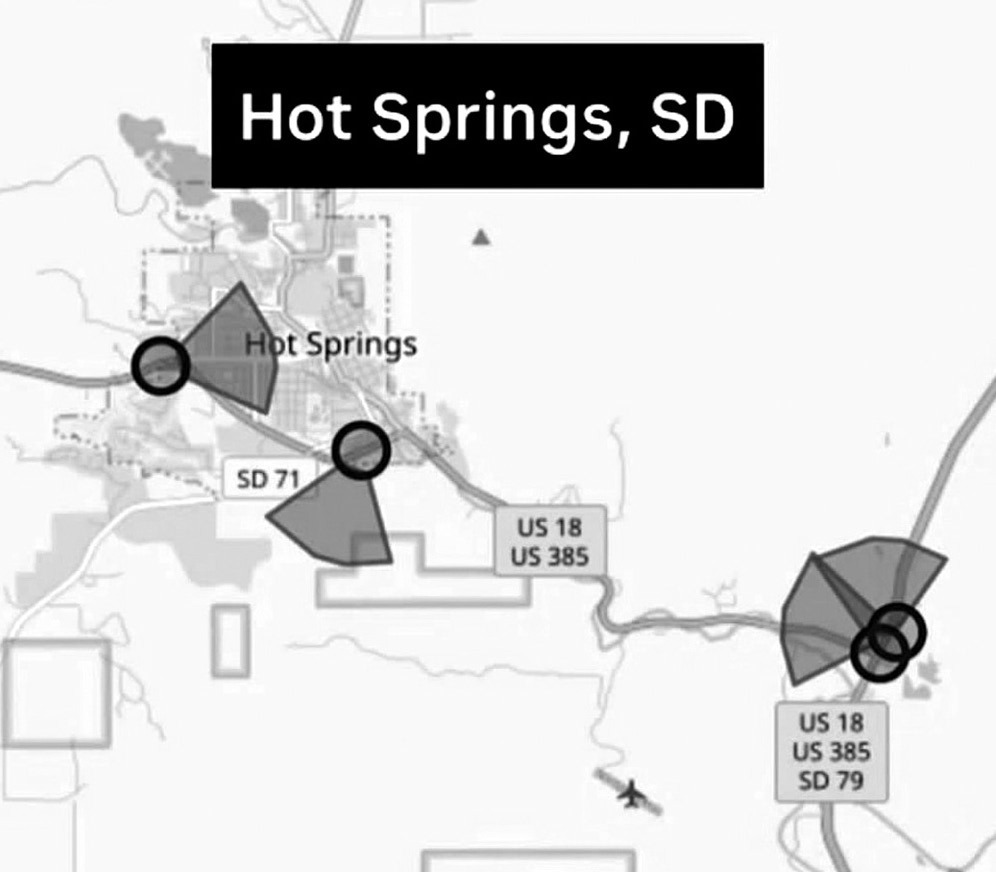
HOT SPRINGS – Automated License Plate Reader (ALPR) cameras have been operational in the Hot Springs area for more than two years, including at Maverick Junction as well as on the Hwy 18 on the southwest edge of town. Recently, their installation has led to questions of government overreach versus public safety with concern from both local citizens as well as organizations such as the American Civil Liberties Union (ACLU), many of whom are claiming that the technology, in reality, creates a surveillance state.
When asked about the cameras, which were first approved by the City of Hot Springs more than two years ago, City Administrator Aerial Allison said, “After rewatching the council meetings where these were discussed, I believe our council focused on the benefits of recovering missing or endangered people and recovering stolen property.”
The city’s Public Safety Committee, in partnership with the South Dakota Division of Criminal Investigation (DCI) who owns and operates the cameras, approved that first installation of the LPR cameras in March of 2024.
In a city council meeting article published March 28, 2024, the Fall River County Herald-Star reported that there was one dissenting vote at the time by then-Ward 2 Alderman Travis Orback, who questioned the authority of the Public Safety Committee to make decisions on behalf of the city.
It was, at that time, explained to the Hot Springs City Council that the cameras were to be used for license plate recognition only in an effort to assist DCI by addressing violent crimes, such as, but not limited to, Amber Alerts, stolen vehicles, kidnappings and more, with an assurance by Ward 2 Alderman Bill Lukens that the cameras were not to be used for facial recognition or stop sign violations.
“No one at the local level, Police of Sheriff, has direct access to the cameras or their data,” said Allison. “If local law enforcement has a case that meets the state’s criteria (endangered person, assault, burglary) they can request LPR data with an associated case number at the discretion of DCI.”
While the definition of an ALPR camera is a specialized video surveillance tool capable of automatically detecting, analyzing and recording license plate information, which can be instantly cross referenced against law enforcement databases, the definition can be construed as eerily similar to Flock cameras with few differences.
The Flock camera is a specific commercial brand of ALPR systems that combines automated license plate recognition, AI, and optional audio/video monitoring. Additional options can include cloud storage, vehicle‑signature search, and nationwide data‑sharing features, with the data collected being owned by the customer who purchased the Flock camera with data deleted after 30 days.
Recently, on public forums on Facebook many citizens questioned the actual use of the cameras and the possible slippery slope to normalization of state surveillance.
“The logical end of a permanent surveillance state is a social credit system which will make you a criminal against whatever arbitrary parameters that the party in power decides to emplace,” stated local resident Cole Wellnitz.
Others on social media have questioned the possible violation of a citizen’s 4th Amendment rights provided under the Constitution.
Yet, the most recent Federal Court ruling in Norfolk, Virg., determined that the use of ALPR’s does not violate a person’s 4th Amendment right, because individuals do not have a reasonable expectation of privacy regarding their movements on public roads.
The DCI also released an educational flyer that addresses those concerns stating that ALPR data is collected only from vehicles traveling on public roadways, only authorized law enforcement personnel are permitted to view or search ALPR data, that every search is logged and subject to audit, the data is retained for 90 days, after which it is automatically overwritten and that Agency policies strictly govern how ALPR information is accessed and used.
Additionally, the DCI clarified in their flyer that the cameras are not facial recognition cameras or software, they are not used to indiscriminately surveil the public, cannot monitor activity on private property, are not set up to capture speed or traffic violations, cannot collect audio and, again, does not collect data indefinitely.
But Wellnitz also questions this form of data collection.
“Tools like these are used by corporate entities to research human behavior and study how they can take advantage of that to manipulate human behavior to their advantage.”
However, continued work to ensure the public’s privacy is in the works.
A recent press release from South Dakota Attorney General Jackley’s Office addressed citizens’ concerns with data collection and information/data dissemination.
According to the press release, Jackley announced plans to propose legislation to ensure that License Plate Reader (LPR) technology is used solely for legitimate law enforcement purposes with strong protections for the public’s privacy.
“I look forward to working with
•
legislators and law enforcement over the coming days to strike the right balance between giving law enforcement the tools needed to protect the public and the privacy of the people we serve,” said Attorney General Jackley. “Limiting LPR use to legitimate investigative purposes and requiring the destruction of data within an established period of time ensures that this technology enhances public safety without compromising individual rights.”
(See related story this page). Regardless of protections promised, many still question the validity of their end use.
“This is one step and a blurred line away from normalization,” said Wellnitz.
Wellnitz’s thoughts are mirrored by many on Fall River County SD Chatroom on Facebook regarding the installation and use of ALPR’s with concerns as to how close we are to being monitored on a daily basis and losing any rights to privacy, possible use for population mechanics and control, the potential for hacking the data and even to go as far as referencing the movie “Hunger Games” being here as well as claims that law enforcement are sovereign citizens creating chaos under the guise of a badge and allowing them even more freedoms to remove our freedoms.
While some are opposed or concerned about the cameras and the data collection, some feel the cameras do, indeed, serve a greater purpose.
“I might make jokes about the cameras, but in reality, they are a great thing,” said Jace Thomas of Hot Springs. “If a fugitive is our loose after murdering someone, or running rampant with a stolen child, this technology can increase the chances o them being found drastically. If it was my family member or child in danger, I would be grateful for the use of any and all technology.
Currently there are 126 tracked Automatic License Plate Readers (ALPR) cameras in South Dakota in 21 cities, with only two of those cities located West River — Rapid City and Hot Springs.
To date, those 126 ALPR’s have aided law enforcement across the state with robberies, kidnapping, child endangerment, stolen vehicles, outof- state fugitive apprehension, drug distribution and more.
According to Allison, who spoke with Hot Springs Police Chief Ross Norton on the matter, the cameras have also aided local law enforcement as well.
“Hot Springs PD has utilized this avenue probably less than a dozen times since they were installed,” said Allison. “A couple of notable instances were a missing person, a fugitive who was located in Hot Springs, and some burglaries.”