
HOT SPRINGS — Logan Brown of the State’s Wildland Fire agency gave a presentation last month on May 13 to County residents about “what they can do ahead of a wildfire” to protect their homes and themselves.
Although a similar meeting two years ago had a larger audience, and many homeowners might be familiar with long-standing firesafety recommendations, such as keeping trees pruned, Brown said he hoped word of the agency’s latest suggestions would reach them. He urged homeowners to look at the information on SD Wildfire’s website.
“A lot of studies and science are behind the recommendations,” which are updated as new data from fires is assessed. “We might have different recommendations from five, or even two, three years ago,” he said. “There’s lots of information, resources that might be available.”
“Home hardening” against wildfire destruction extends in a 100foot perimeter, or the “home ignition zone,” he explained. Within that perimeter are three zones: the first, where it is “most critical to reduce” flammability is the “immediate” zone consisting of the home and surrounding five feet.
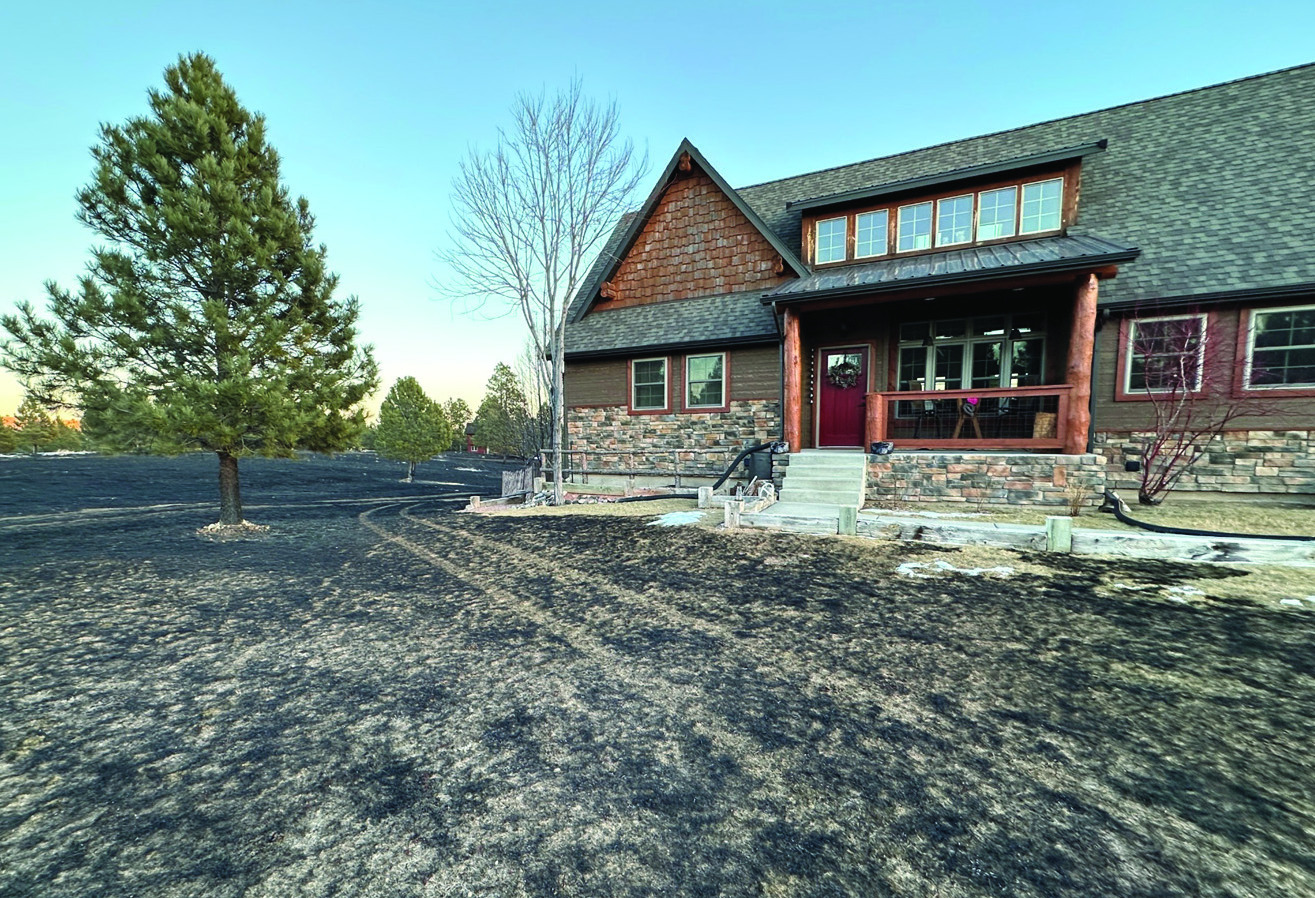
Making sure the critical fivefoot perimeter is fire-proof would save about 90 percent of homes exposed to wildfires. “We saw this in the Skyline Fire of January 27, 2025, when a wildfire burned up to a house and all around it,” but left the home intact because of the exterior landscaping that featured an inflammable perimeter.
Noting that the Skyline Fire was moving so quickly, as many wildfires do, that it had reached the house before firefighters were able to get there, he emphasized the importance of being proactive in preventing one’s home from burning.
“Landscaping with rocks [stone or concrete] around a house, “ideally for five feet but at least two-three feet can make a huge difference.” Brown emphasized not only replacing “mulch with rocks,” but making sure nothing flammable is under decks. “Cleaning out under decks is definitely overlooked,” with people either neglecting flammable material there, or not being able to reach such material.”
While the popular conception of wildfire danger is of flames engulfing a home, the real culprits are embers blown ahead of the flames which then combust in flammable material near the house and generate a direct flame on the structure. “Even if there’s a roaring crown flame, it’s the pine needles in a gutter” — or underneath a deck — which, when ignited by embers, enable “direct flame contact” that burns down the house.
Brown said he suggests homeowners assess their property’s fire risk by envisioning thousands of lit matches have been thrown on their land. “Are there pine needles that have blown against your house? If the answer is yes, then you probably want to clean those up.”
The next zone in home hardening is the intermediate zone, from five to 30 feet, where “trees need to be limbed up, spaced out so that you don’t get a fire going from canopy to canopy.” Lawns should be mowed to a maximum height of four to six inches, “so that fire burning that short grass” fizzles out.
Finally, from 30 to 100 feet from the house is the extended zone, where the focus should be on mitigating possible fire fuels. “Cut lower limbs from trees so if a fire is moving through the grass, it doesn’t get into the tree” which would increase the fire’s intensity. A hundred feet away from one home, Brown noted, might mean someone else’s property “so it’s important to work with your neighbors as well,” educating them on wildfire-reduction options.
Brown’s briefing also detailed the classic ‘ready, set, go’ process for evacuation during a wildfire; “We’ve already had a fair amount of evacuations in South Dakota this year.”
Being ‘ready,’ includes advance planning about “where you would go and how you would get there,” as well as preparing a “go bag” with essentials such as insurance documents and medications. Signing up with the County’s contact list for emergency notifications would also be important to do ahead of time.
If a wildfire has started nearby, it would be time to get ‘set’, to have “situational awareness,” such as checking social media or listening to the radio. “Your vehicle should be backed into the driveway” for a quick departure, and “you should assess whether what you’re wearing is practical — you might have to wear it for a few days.”
At the ‘go’ point — “whether it’s he sheriff knocking on the door or smoke impacts on your health,” Brown listed his “Six P’s: people, pets, personal needs, prescriptions, papers, especially insurance documents, priceless treasures such as family photos.” For more information, he suggested ready.gov or Fall River County’s Emergency Management page.
“There is a drought” in the region, he concluded, and the “summer season is expected to be hotter and drier” than average — “we’re already seeing that.” Such conditions mean that fires can start more easily, move quickly and become more intense. While “any rain is helpful,” what the area needs is “a week of long, steady rain that can soak into the soil versus a quick downfall that mostly runs off.”
To deal with the situation, “We’ve brought on seasonal firefighters earlier, and we can bring in ‘severity resources,’ [such as fire engines] we’ve already brought in some engines from other locales.”
The meeting was held at the Ambulance Service building next to the hospital and was organized by the County Club Estates subdivision homeowners association.