
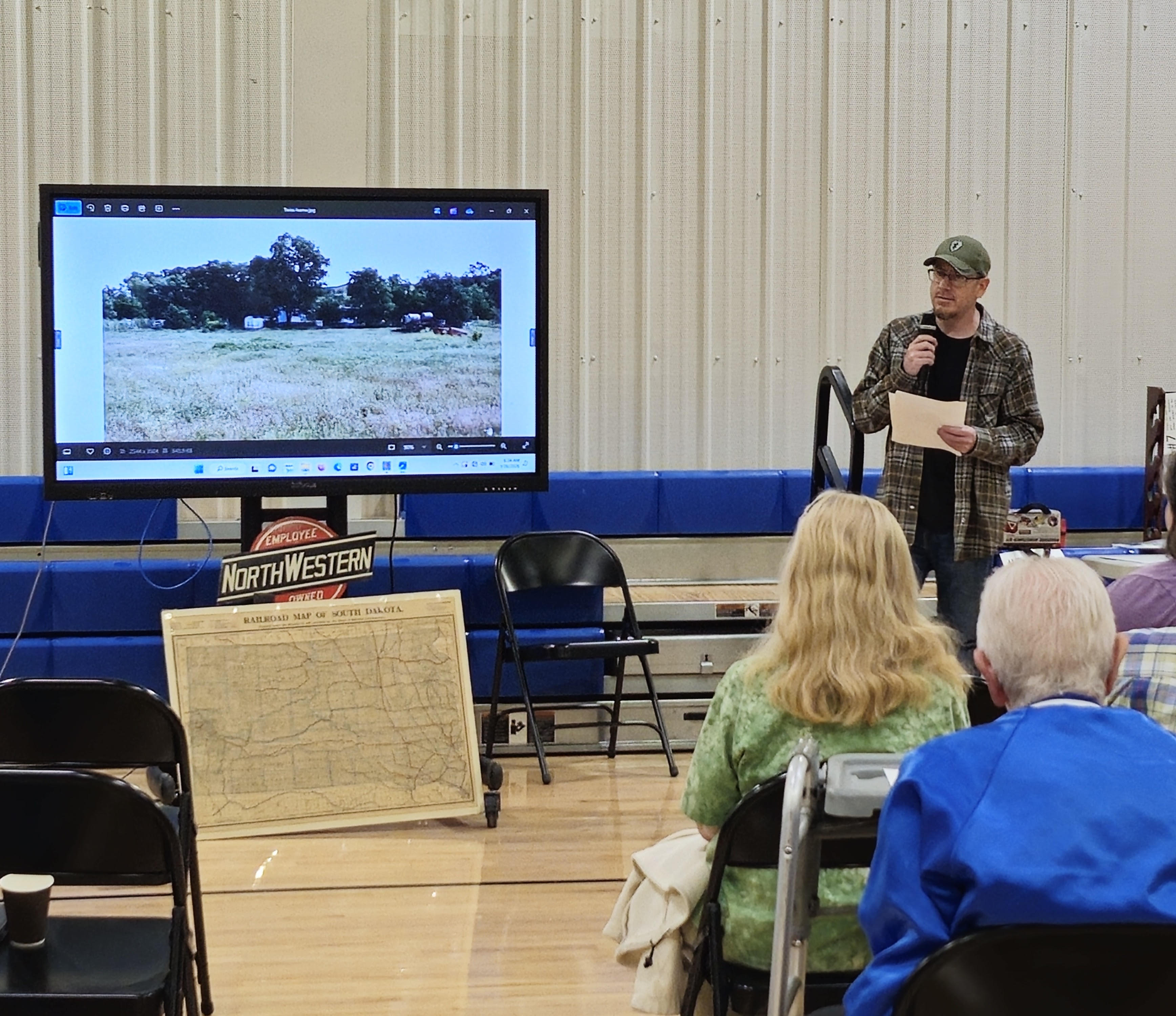
OELRICHS – On Sunday, April 19, a crowd of 65 people gathered at the Oelrichs High School gym to learn about thehistoryoftheOelrichsarea.Attendees of the annual history conference, hosted by the Oelrichs Historical Society, enjoyed knowledgeable speakers on a wide range of topics.
Ken Updike was recruited from the Oelrichs School to share his knowledge of the birth of the United States of America, which turns 250 years old this year. Updike has been an educator at the school for over 20 years, teaching history to many eager minds.
Updike explained that religion, politics, and economics led to the settlement of the country. He went way back to the Bible; he went back to the love life of King Henry VIII; and he explained the relevance of Robin Hood and his band of merry men. Colonists refused to pay taxes to Great Britain from 1763-1776 and then won the American Revolution. Updike said, “No other Republic has lasted this long.” – 250 years!
Local historian and lifelong learner, Louis Twiss, turned 90 years old earlier this month. He and his son, Dustin Twiss, presented the history of the collaboration between William Twiss and Harry Oelrichs, for whom Oelrichs is named.
Harry Oelrichs was the superintendent of the Anglo-American Cattle Company, who bought up large ranches in Fall River County and ran 35,000 head of cattle. In 1887 he built an abattoir (slaughterhouse) in Oelrichs and shipped beef to the East.
William Twiss was a son of Major Thomas Twiss, the Indian Agent for the Upper Platte Agency in the Office of Indian Affairs. William’s mother, Mary Standing Elk, was an Oglala Lakota and the daughter of Chief Standing Elk. On a side note, Harry Oelrichs befriended Standing Elk and was pictured with him in front of Oelrichs’ house in 1887.
The Twiss family were the first known residents of Cuny Table, as they were living there as early as 1877. William Twiss became the cattle foreman at the Pine Ridge Indian Reservation in the 1880s. Cuny Table was the area where the first government beef herd was located.
Records indicate Harry Oelrichs trailed cattle to Cuny Table, and then Twiss trailed the cattle from Cuny Table to the corrals just east of Pine Ridge. They delivered a herd every two weeks. The agency would then distribute the cattle to families assigned to receive a beef that week. They would turn the beef out; the family would kill it, butcher it, and divide it right there. Later, they would put the cattle through a chute to manage the capture.
Louis Twiss found a receipt that shows the average weight of a beef to be 887 pounds. He pointed out this would not have resulted in enough processed meat to feed a family for very long. According to the 1890 census, there were 20,000 individuals on the Pine Ridge reservation.
The audience asked many excellent questions, including “How did William get the job of beef foreman for the tribe so young?” (He was 18-19 years old.) Louis indicated there are still some gaps to fill in the history, but he assumes it was because William’s father, Thomas, had a record of fair dealings when he was an Indian Agent. Louis pointed out William likely had the ability to work well with both natives and whites as he was onehalf Lakota.
Louis remembers his grandfather, William, and grandmother, Elizabeth Cuny. William is responsible for transplanting many of the trees that still exist on their ranch at Cuny Table.
William passed away shortly before the 125 families on Cuny Table were forced to leave in 1942, so the government could build a bombing range in the badlands during World War II. The family was allowed to buy back their land in 1968.
The science teacher from Oelrichs School, James Willmus, took up where Rick Mills, railroad enthusiast and renowned historian, left off at last year’s conference. Mills passed away shortly after the conference, leaving his protégé to complete his work. Willmus is a builder of model railroads and acts as the SD State Railroad Museum’s interim director.
Willmus concentrated on the rail line from Chadron to Belle Fourche and shared a picture of the Oelrichs train depot from 1915. The Fremont, Elkhorn, and Missouri was the first railroad to come past Oelrichs in 1884 and provided a link between other lines.
The railroad hauled cattle from the area ranches to the Union Stockyards in Omaha, NE. Cowboys went along in drovers’ cars, and the train pulled a couple of cars for their horses. There were also passenger cars from Oelrichs, but those ended in the 1950s.
Trains continue to roll past Oelrichs with freight twice a week on the Rapid City, Pierre, and Eastern line. It runs from northeastern Wyoming through Sturgis, Rapid City, Dakota Junction, and Crawford. It connects with other lines.
Willmus fielded some great questions about the quality of track and new innovations in rails. The audience also included individuals who had previously worked for the railroad that were able to insert personal stories and help answer questions.
Roy Merdanian III, President of the Oelrichs Historical Society, said, “We are pleased with the turnout. I seems like we’re growing every year. We are glad to see the interest in local history.”