
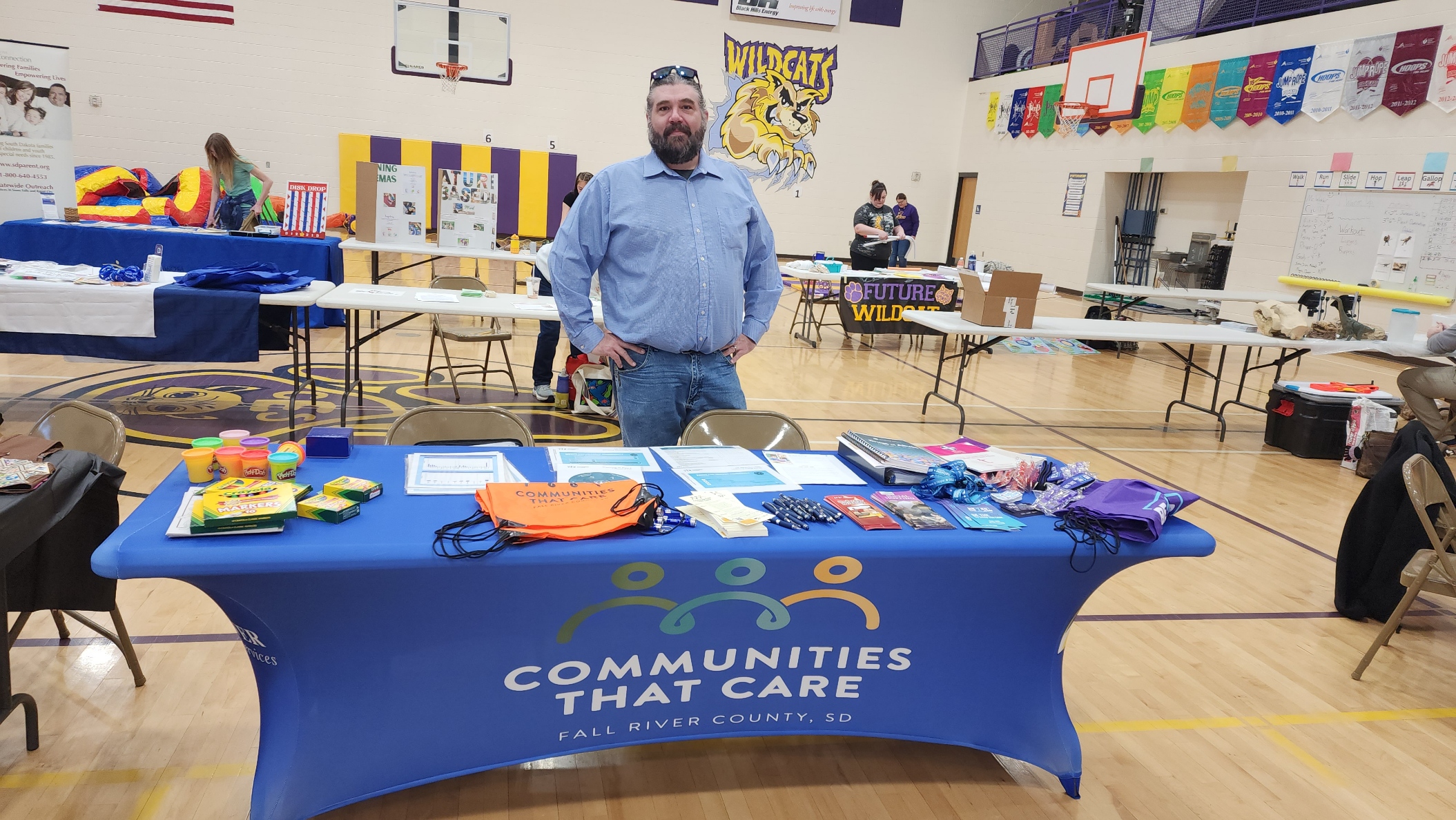
HOT SPRINGS – Alexander Nelson, age 39, calls himself “the helpful type,” and after working with troubled youth at the now-defunct Star Academy and with the state’s child-protection services, he’s taken on trying to prevent the problems he encountered during those years with a new initiative in Fall River County called Communities That Care (CTC).
With his sense of humor, empathy for kids, creative thinking about solutions for the whole community — and discreet ponytail— he’s a good choice to tackle the situation.
Fall River’s CTC is an affiliate of a 30-yearold national organization based at the University of Washington’s School of Social Work and was initiated by Fall River Health Services. The organization’s goals are to generate community-wide programs that address the contemporary challenges of kids, starting as young as third/fourth grade and continuing through high school.
“The state Department of Health had an opportunity to bring CTC to a handful of communities,” Nelson said, and when Fall River Health heard about the program, they wanted to apply but needed a Coalition Coordinator with the experience and skills to make it a success. They hired Nelson in May 2022 and garnered one of the state grants.
The CTC process involves assembling a board and “bringing key leaders together with representation from different groups, from school boards, educators, law enforcement,” said Nelson. He also did a “resource assessment” of what options were already in place to address youth problems and did a student survey in the county’s schools, asking kids in grades 6,8,10 and 12 to report their attitudes and opinions on a variety of emotional and health issues.
“We saw some pretty interesting results,” Nelson said. “For risk factors, we were high in the ‘bad’ categories, and low in the good ones,” compared with national averages — although typical for rural and poor counties. For example, “upwards of 60% of kids reported depressive symptoms” and many had “low commitment to school,” exacerbated by Covid — but only a small percentage had negative views “about doing drugs; they don’t perceive the harm,” he said. That combination can lead to youth drug and alcohol addiction, he noted.
Fall River County kids are “about average in terms of being “pro social activity’ such as involvement in sports and other extracurricular activities.Aproblem,however, is that such a ‘protective’ quality for healthy kids is a challenge in a county which is an older community, and where there’s “not so much for them to do.” That’s one example where CTC wants to involve the entire community, not just schools, in addressing such a challenge.
Other protective CTC measures include teaching children key life skills such as how to regulate emotions — and how to say no. Nancy Reagan aside, the data shows that “if you can get a kid to say no to one addictive substance” — such as nicotine, usually the first circulating among peers — “they’re more likely to say no later,” to alcohol or cannabis said Nelson.
CTC offers “a buffet of programs” that have been tested and proved effective for schools, he said, such as one on vaping dangers called ‘Catch My Breath’ which Hot Springs High School and Oelrichs are doing, and ‘Too Good for Drugs,’ targeted at grades 6-8, “teaching life skills, applied to realworld situations, to beef up kids’ ability to say no — and why,”in Edgemont.
Hot Springs High School and the Boys and Girls Club are also launching “a little test program” with the (Dr.) Botvin curriculum, which Nelson described as having some materials “that are a little dated” — with references to CDs and tape players, for example — but whose concepts are “timeless, poignant and proven effective.”
CTC programs also include Quit Kits to help adults and youth with nicotine addiction and an initiative focused on parents, caregivers and others interacting with kids such as a grocery- store manager called Everyday Strong, helping adults engage teens on their level to widen the protective environment for the community’s youth (jointly sponsored by the United Way of the Black Hills and Fall River Health Services).
Other upcoming CTC events include a Sunday Funday on October 6 in Centennial Park and an Opioid Awareness event on October 22 and 23 at the Ambulance Shed near the hospital, where Naloxone kits — which can prevent a fatal overdose — will be distributed. “It’s as important for Granny to have one in case a grandchild accidentally swallows a prescription pain pill as for harm reduction for those using substances,” he said.
Nelson wants CTC to work with other non-profits in the county which also “want to better the community,” not to duplicate resources but “to help them fulfill their mission goals or grant requirements.” For example, “bringing kids to volunteer for Keep Hot Springs Beautiful, to teach them how to get engaged in their community” by helping with the plants in the downtown’s bump-outs.
Nelson, raised in Mitchell and a South Dakota State University history graduate, hopes CTC can be part of a resurgence of communitywide cooperation. “As a Western historian, I know how all these prairie towns popped up with mutual support” playing a key role, he said, “with farmer coops negotiating the best prices with the railroads. That all went away but it’s starting to come back.
The survey data is available on the Fall River CTC website, as is contact information (www.fallriverctc.org).