
HOT SPRINGS – The need for the rebirth of ‘Save the VA’ is because the “battle is not over,” according to Don Ackerman, who served as the host of a public meeting held last Friday, March 14, in the Mueller Civic Center.
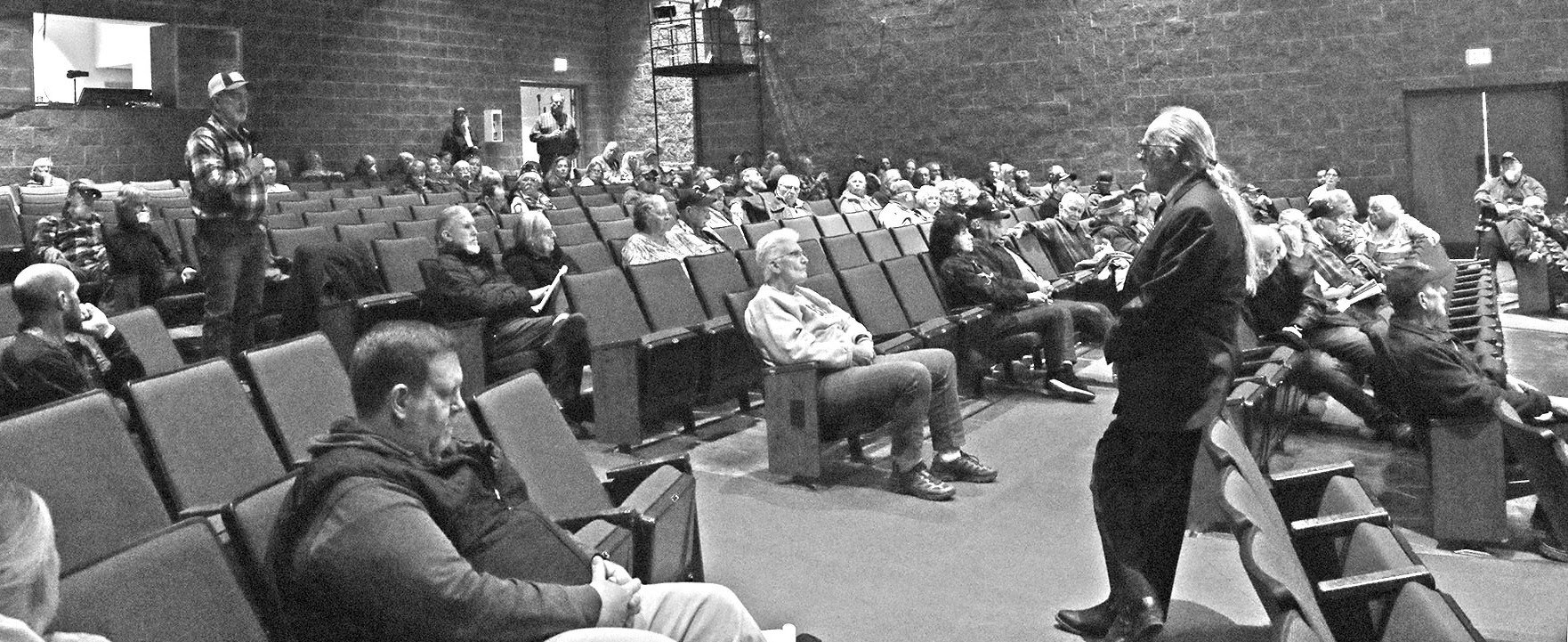
More than 150 people attended the two-hour presentation in the theatre, where the message was to contact VA officials in Washington D.C. and elsewhere and bring attention to the ongoing deterioration of personnel and services on the campus of the Hot Springs VA.
In addition to Save the VA volunteers, participants also included representatives of South Dakota’s congressional delegation seated on stage in primarily a non-speaking role. Also on stage were District 30 Representative Trish Ladner, Edgemont Mayor Rheta Reagan and Christopher Dean with the Crawford, Neb., American Legion. District 30 Sen. Amber Hulse joined by video conference.
The meeting began with Save the VA co-founder Pat Russell briefly summarizing the events of the past 13-plus years since Dec. 12, 2011, when Stephen DiStasio – thendirector of the VA Black Hills Health Care System – announced a plan to realign the Hot Springs VA and eventually close the campus within five years.
Nine days after that meeting was held inside the same Mueller Center Theatre in front of a standing-roomonly audienceofmorethan400people, a second meeting was held at the Hot Springs American Legion where 14 different goal-oriented committees were formed, utilizing the talents of more than 150 volunteers. From those meetings, a counter-campaign was established by the community with the slogan “What Our Veterans Earned, We Deliver” which had a goal to not only keep the Hot Springs VA open, but also grow the services that were available.
The three-year Environmental Impact Study was started by the federal government in 2013 under the leadership of then-VA Secretary Eric Shinseki (2009 – 2014). The VA later issued its final impact statement on Nov. 10, 2016, which was the final procedural step prior to the new VA Secretary Bob McDonald’s (2014 – 2017) decision to shutter the facility.
Two years later, thanks to the efforts of South Dakota’s congressional delegation, the new VA Secretary Robert Wilkie (20182021) held true to his word that he would visit the Hot Springs VA.
On March 3, 2020, Sec. Wilkie held a press conference in Hot Springs – with Sens. John Thune and Mike Rounds, along with Rep. Dusty Johnson, and Governor Kristi Noem – where he said he wants to take another look at the previous administration’s record of decision.
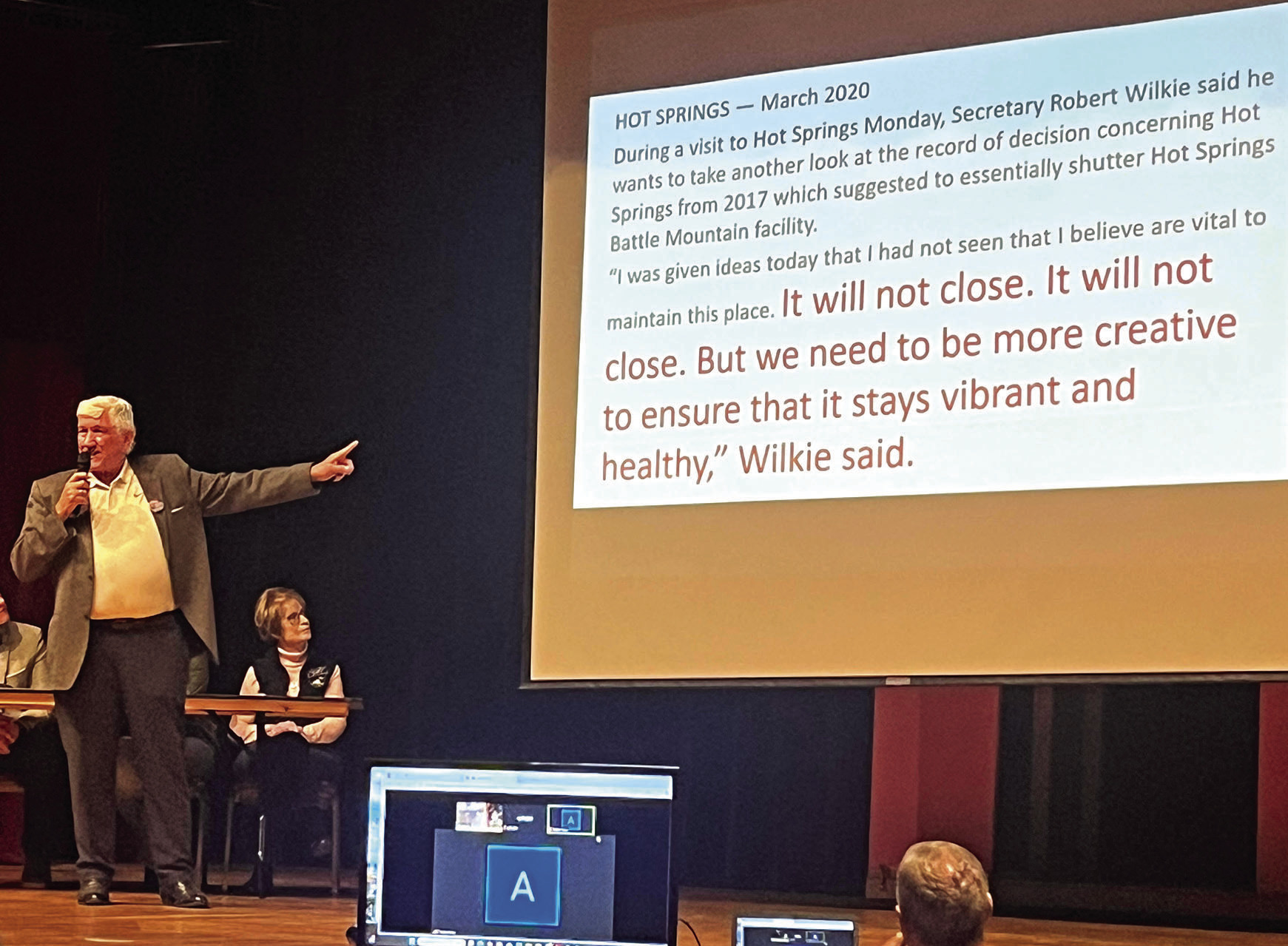
“I was given ideas today that I had not seen that I believe are vital to maintain this place,” Sec. Wilkie said. “It will not close. It will not close. But we need to be more creative to ensure that it stays vibrant and healthy.”
Sec. Wilkie’s 2020 statement and rescission of Sec. McDonald’s record of decision was seen as a big victory for the community of Hot Springs and the veterans served by the Hot Springs VA, but another battle was on the horizon in the form of an Asset and Infrastructure Review (AIR) commission that was considering moving VA medical center services from Hot Springs to Rapid City, to include inpatient and outpatient care, nursing home and rehabilitation services.
Again, thanks to South Dakota’s congressional delegation, that plan too was thwarted when Sen. Rounds and others, who were also members of the Senate Veterans Affairs Committee, made a decision to not confirm anyone to serve on the AIR commission. This action by the committee then essentially killed the AIR commission’s plan to streamline services nationwide, and Sen. Rounds came to Hot Springs in June 2022 and made the announcement in person.
Russell said Sen. Rounds’ announcement three years ago provided a big sigh of relief, however, he still had considerable concerns that the VA might “scale back the qualify of care over the next several years.”
“That is exactly what they have done,” Russell stated with a raised voice, while speaking on stage last Friday night in the Mueller Center Theater. “They’ve taken away positions; they’ve transferred people and a number of our physicians up to Fort Meade; they’ve taken away services. There’s no in-patient care; there’s no emergency room. Urgent Care has been decreased and they’re just picking away at our VA brick by brick by brick.”
Russell added that South Dakota’s congressional delegation did their job in supporting area veterans and the Secretary of the VA gave a promise that “it will not close.”
“But VA management at VISN 23 in Eagan, Minn.,” Russell stated, “and the director there, Rob McDivitt, and our director of the Black Hills Healthcare System, Spencer Mion, they are doing their best to pick away at the Hot Springs VA until eventually, they’re going to say the quality of care is so low that we cannot keep our veterans there, so for their safety, we must close you. They are doing this intentionally.”
Ackerman then came back on stage and went through a slide show presentation that highlighted some of the changes at the Hot Springs VA in recent years, which Russell referenced in his speech. One of his first slides showed a graphic that, in 2020, the Hot Springs VA had 100 beds available in the domiciliary. Now however, Ackerman said the current usage is only 30 beds.
Ackerman also had slides describing the number of medical staffs in each department and also listed some scans and other services which he said were no longer available here. In addition, he said there are no longer emergency room services and the Urgent Care is only available Monday through Friday, 7:30 am to 4 pm.
Ackerman also said that the VA’s “Care in the Community” initiative to have community healthcare facilities provide services to veterans is not working, in part because the VA does not adequately reimburse privatelyoperated medical facilities in local communities. He also mocked the VA for having an ambulance in Hot Springs, but being unable to utilize it due to lack of staff, he said.
At the conclusion of Ackerman’s slide show, audience members – who were asked by Ackerman not to share their names out of potential fear of repercussions – were then given the opportunity to stand and share their thoughts on the situation, which lasted for more than an hour. Comments were shared by a variety of people, including veterans who receive care at either the Hot Springs or Fort Meade VA’s, as well as spouses of Veterans and also a few employees of the Hot Springs VA.
One speaker who did identify himself as “Dr. Rick – the one guy at the Dom” was welcomed by a large round of applause when he stood to talk midway through the public participation portion of the meeting.
Speaking from his first-hand account as a physician at the Hot Springs VA, “Dr. Rick,” aka Dr. Plummer, who has been in healthcare for 40 years with his most recent boards specializing in addiction, spoke to the audience and said, “You’re here for good reason and you all should be worried and you should become very political because nobody is listening.”
After describing how much he loves working at the Hot Springs VA and his commitment to the care of the Veterans here, Dr. Rick said “I want to do everything I can to keep it going the way it has been and in the tradition of healing … But you can’t do more with less. Not at this point, they’ve cut way too far back.”
He said there is an excellent staff in Hot Springs but there’s just too few of them, “and that’s a big issue.” He added that he is “on the side” of the Veterans “to weld this thing together,” but that he was “really at a loss of how to do it” and “where to start, because there are so many areas that need attention.”
“Everything I’ve heard here tonight is true, every bit of it,” he said.
One suggestion that Dr. Rick did have, which would help bring more physicians to the Hot Springs VA, was to bring in medical school students and make the facility a focus of education. He said that when he moved to Hot Springs he was told that the concept had been considered previously and might still be an option.
About 20 different members of the audience spoke during the meeting, beginning with a woman who said she had attended a march held earlier in the day in Rapid City to protest some of the Trump Administration’s recent federal spending cuts, specifically related to the Veterans Administration. While at the march, the woman met an employee of the Fort Meade VA who expressed his concern about the staffing shortages in the Black Hills.
A man spoke next and shared how the Hot Springs VA had saved his life and how it needs to stay open.
Next, a woman shared how she had a bad experience with the VA but still did not want it to close. She said her husband of 40-plus years died in 2021 at the age of 59, which she blames in part due to inexperienced medical staff. She also said she has friends who are Veterans but have to wait more than a month to get an appointment to see a physician at the VA.
Another man identified himself as a 2015 Air Force retiree who recently moved to the area. He expressed concern about how slow the process is to get travel vouchers processed in regards to seeking communitybased medical care outside the VA system.
Veteran mental health was a topic brought up by multiple audience members and how the suicide rate of Veterans needs to be a focus. Several audience members said the Hot Springs VA’s rural setting is an ideal location for Veterans suffering from PTSD and addiction recovery.
Towards the end of the audience member input portion of the meeting, a man stood and identified himself as a 10-year employee of the Hot Springs VA, who is also a Marine Corps Veteran. He said he did not plan to speak during the meeting but was inclined to do so after hearing everyone express their concerns. He said the staff of the Hot Springs VA truly care for the Veterans and want to do the best for them. As others had stated, he said Hot Springs is ideally located and suited for recovery.
He said another unique aspect of the Hot Springs VA is that its the only VA hospital in the country that has a dialysis unit which also helps non-Veterans. “So if you close this facility down, not only will the Veterans have to go find somewhere else, so will the non-Veterans who are using that facility,” he said.
The man also agreed with Russell’s and Ackerman’s previous comments that the VA is slowly tearing down Hot Springs’ services “brick by brick.”
“Being here 10 years, I’ve seen that happen non-stop. That’s the name of the game,” he said, while describing how the emergency and urgent care had gone from 24/7 to now how there is only a doctor available for urgent care five days per week for only about eight-and-ahalf hours each day.
The man also described how not having 24/7 urgent and acute care on staff ends up costing the VA much more money due to oftentimes having to send patients to Fall River Hospital, or sometimes to Rapid City by Lifeflight helicopter where they often spend time in ICU.
“At what point is there not a cost savings of having a provider up there 24/7?” he asked.
Later in his talk, the man said, “Every day I’m in there seeing things and it just irritates me, as a Veteran, to see how my fellow Veterans are being cared for and the things that are happening.”
The meeting concluded with some of the guests on stage saying a few words, including Christopher Dean with the Post 138 American Legion in Crawford, Neb., who said the care and staff of the Hot Springs VA is top notch and should be a model to base every other VA in the country.
“The people here are amazing. They are doing God’s work with no help, no back up,” he said. His comments were followed by applause and cheers from many people in the audience.
The three representatives for the Congressional leaders also spoke briefly and were appreciative for being invited to the event and assured the audience that South Dakota’s leaders in Washington D.C., have been and remain in support of the Hot Springs VA.
Russell came back on stage to close out the meeting and urged the audience members to send letters and other expressions of support to leaders in Washington, D.C., specifically the recently installed new V.A. Secretary Doug Collins. The organizers of meeting also provided addresses and envelopes of who to contact.